
Where Lyon County Recent Arrests First Appear
The Lyon County Sheriff's Department puts out two official PDFs. One is the Jail Inmate Roster. Think of it as a custody snapshot, showing who is held right now. The other is the Arrest Press Log. It is a rolling history of arrests and releases covering roughly 30 days. Neither PDF shows booking photographs. Neither promises a new entry at a fixed minute, either. The jail sits inside the Law Enforcement Center. It takes people brought in by sheriff's deputies, Iowa State Troopers, DCI and DNR officers, federal agents, and other agencies. That mix explains why the press log lists more than sheriff-only arrests. The official Lyon County Jail page gathers the roster and arrest log in one place. Warrant, wanted, and jail links sit there too.
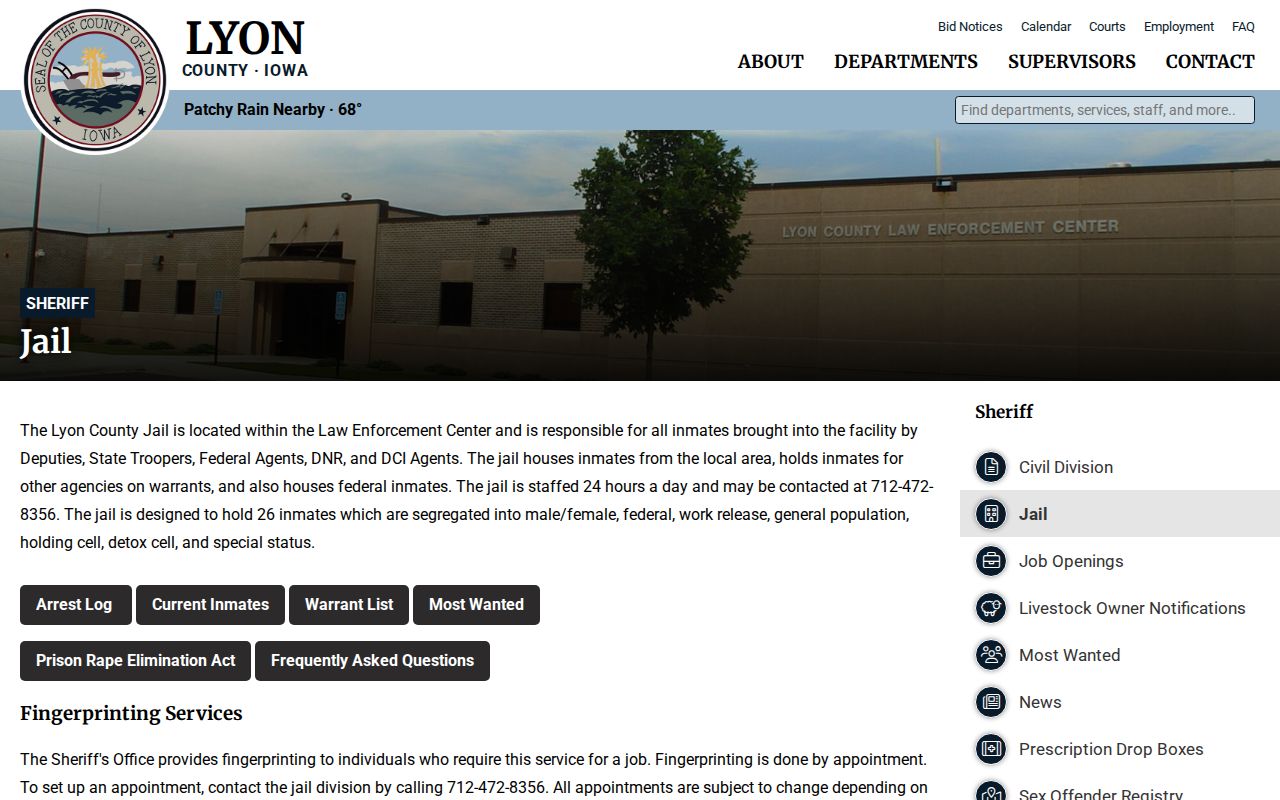
Treat that county page as the starting point. Open whichever source matches the status and date in question.
| Official view | Time scope | Best use | Photos |
|---|---|---|---|
| Jail Inmate Roster | Current operational snapshot | Who is listed in local custody now | None in the inspected PDF |
| Arrest Press Log | Rolling period of about 30 days | Recent arrest, agency, charge, bond, or release | None in the inspected PDF |
| Sheriff News | Releases available up to six months | Selected official incident releases | Not a booking-photo feed |
| Iowa Courts Online | Case history after entry | Filings and dispositions | Not a mugshot source |
A new booking does not always appear right away. For an urgent custody question, call the jail at (712) 472-8356.
Checking Someone Arrested Last Night
Lyon County offers no dedicated view limited to the last 24 hours. For a same-day question, work the fallback. Check the timestamp on the current roster. Then search the Arrest Press Log by the person's name. Compare the arrest date against any release field. A person can be arrested and released before the roster regenerates. Someone might also be held for another agency or on a warrant. The detailed 24 Hour Arrests guide walks through that short-window approach. It does not pretend the county runs a live same-day feed. For tracking one person's custody, IowaVINE sends notices. These cover release, transfer, escape, or death. It is a notification system, not an arrest log, and new bookings can lag. Search the county PDFs first. Treat the jail line as the final word. A missing name alone cannot establish present local custody.
Reading the Lyon County Jail Roster
The official roster is a generated PDF, not an interactive name database. It lists people held at Lyon County Jail. Some are local inmates, and some are held for other agencies or federal authorities. Staffing runs around the clock. The jail was designed for 26 people. That figure says nothing about how many are actually held on a given day. An entry that lingers for months reflects custody duration, not a permanent archive.
| Roster field | What it means |
|---|---|
| Date Booked In | The jail’s recorded booking date, which may differ from the arrest date. |
| Inmate Name | The displayed identifier; confirm spelling and identity. |
| Charge | The charge recorded at booking, still only an charge. |
| Bond Amt | The amount shown at snapshot time; a court can change it. |
| Reason Booked Desc | A short administrative or legal description, not a disposition. |
Open the PDF from the jail page and note its generation time. Use the browser's PDF find command. Enter the exact spelling of the name. Read the whole row so bond and reason stay attached to the name. If no match appears, check the press log for a release, then call the jail. The county lists no sheriff-branded booking app. Its official alert option is IowaVINE, covered in the VINELink Check guide.
Booking is administrative intake, bond is a court-controlled release condition, disposition is the later case outcome, and expungement is a legal process that can make an eligible court record confidential.
Lyon County Arrest Publication Channels
Official sources should lead every search. They define their own records and can correct them. Local newspapers may add context later. Commercial indexes can be incomplete, delayed, or simply wrong, so a third-party result never proves that someone remains in custody.
| Channel | Official? | Photo? | How to use it |
|---|---|---|---|
| Jail Inmate Roster | Yes, county | No in inspected PDF | Current local-custody check |
| Arrest Press Log | Yes, county | No | Rolling arrest and release history |
| Sheriff News | Yes, county | Varies by release | Selected official incident accounts |
| Lyon County Reporter | No, local news | Varies | Weekly reporting, not a live roster |
| West Lyon Herald | No, local news | Varies | Later west-county news coverage |
| Commercial arrest indexes | No | Claims vary | Secondary leads only; verify officially |
One large commercial index claims a 30-day view of Lyon County. It notes that the county provides no mugshot images. Other big indexes carry no reliable county-local results. Coverage that uneven is why no commercial mugshot collections are linked or rehosted here. County records come first. Local journalism follows later, and commercial material serves only as a caveated lead.
Recent Arrests by Lyon County City
City location does not create a separate jail feed. Rock Rapids, George, and Inwood bookings all flow into the same sheriff roster and press log once they reach the county facility. The record custodian can still differ, though.
- Rock Rapids Recent Arrests: the city has a police department, while prisoners are taken to the county jail under city code.
- George Recent Arrests: the city contracts with the Lyon County Sheriff for law-enforcement service.
- Inwood Recent Arrests: city materials likewise document contracted sheriff service.
Search the county feed for all three places. For a municipal police record from Rock Rapids, the city office is the practical contact. For George and Inwood enforcement records, start with the sheriff unless the city office holds the exact municipal document.
What a Lyon County Arrest Record Contains
One Lyon County arrest creates several connected records. Each has its own fields. The current roster emphasizes custody. The press log adds incident context and can keep an arrest visible after release. A later court docket shows what prosecutors filed. It also shows how the court handled it. Keep those stages separate rather than merging them into one assumed outcome.
| Field | What it shows |
|---|---|
| Name, age, and sex | Identifiers supplied in the log; not proof of a same-name match. |
| Arrest date and location | Where the arrest was recorded, not necessarily residence or booking time. |
| Agency and incident number | The arresting office and a useful request reference. |
| Charge, code, and count | The charge as logged; it may later change. |
| Warrant number | A reference when applicable, not a full status check. |
| Bond amount and type | Release terms shown at that moment. |
| Release date or reason | A custody event, not the case disposition. |
| Booking photo or number | Not shown as a dedicated field in the public PDFs. |
Those stages stay distinct in the county PDFs. A roster row, press-log entry, or booking record documents its own moment only.
Lyon County Mugshots After an Arrest
The Lyon County roster and its arrest-log PDFs offer text and tables, not booking photographs. No county mugshot gallery exists on either one. Iowa DOC's offender-detail page shows no photo either. That system tracks state corrections and supervision, not ordinary county pretrial custody anyway.
If a booking photo exists, the office that holds it can tell you whether Iowa Code Chapter 22 makes the image public. Give the person's name, an approximate arrest date, the arresting agency, and any incident number. The custodian can lawfully restrict some photos. Investigative, juvenile, sealed, confidential, and safety-based limits all apply. Chapter 22 sets no duty to publish booking photos. It also lacks a dedicated anti-pay-to-remove provision.
Commercial sites often keep an old mugshot after the official record changes. Fix the source first. Once the official record is corrected, sealed, or expunged, seek a free correction through the publisher's own policy. Skip anyone demanding payment for guaranteed removal from every search engine. That promise cannot honestly be made.
Requesting a Lyon County Arrest Record
The Lyon County Sheriff's Department holds the jail, press-log, and sheriff incident records. Start your request there. Iowa's Public Information Board allows written, telephone, or electronic requests. You can ask for electronic production when feasible. No fixed local booking-record fee or turnaround is published. So request an estimate before approving copying or extensive retrieval.
- Write down the person’s full name, approximate date, agency, location, and incident number if available.
- Describe the exact item needed, such as an incident report, booking record, release entry, or photograph.
- Send the request to the Lyon County Sheriff at 410 S. Boone St., Rock Rapids, Iowa 51246, or call (712) 472-8300 for the correct route.
- Ask for an electronic copy when practical and request an advance cost estimate.
- If material is withheld, ask for the legal basis and whether a nonconfidential part can be released.
Court filings and final results live elsewhere. Iowa Courts Online is the free starting point. The Lyon County Clerk of Court can also be reached at (712) 472-8530. Dismissals, acquittals, and some misdemeanors may qualify for expungement under Iowa Code sections 901C.2 and 901C.3. Eligibility, waiting periods, and effects all vary. Iowa courts provide the forms, but case advice belongs with a licensed attorney.
Iowa Law, Retention, and Arrest Records
Iowa Code Chapter 22 favors access. Then section 22.7 and other laws step in. Investigative details, juvenile material, sealed files, confidential data, and safety risks can all be withheld. The real question is narrow. It asks whether this particular record is open, not whether everything tied to an arrest is public. The Iowa Public Information Board Chapter 22 guide explains request methods and reasonable actual costs.
A guide helps you frame a specific request, while exemption decisions stay with the lawful custodian. Online visibility is not formal retention. The press log runs roughly 30 days. Sheriff news can stay posted for up to six months. The jail-retention rule covers named administrative, medical, inspection, injury, and property records. It sets no booking-photo period. Older items may sit with the sheriff, move into a court file, transfer to an archive, or be destroyed under an approved schedule. Ask which happened. The State Historical Society's Lyon County listing shows no sheriff or jail booking series.
Lyon County Arrest Warrants and Most Wanted
The Sheriff's Department posts an official Warrant List PDF. It runs separate Most Wanted and confidential crime-tip pages. None of these confirms a warrant. A PDF can change after you download it. Courts issue, recall, quash, and satisfy warrants constantly. Call the sheriff's non-emergency line, or ask a lawyer, to verify a warrant involving you. Never use public data to dodge service or law enforcement. The official Lyon County Most Wanted page is the county's source for selected notices.
Never approach a listed person. Report locations to dispatch at (712) 472-8300, and reserve 911 for true emergencies.
After a Lyon County Arrest Reaches Court
Booking, release, and disposition run on separate clocks. A jailed person usually sees a magistrate within 24 hours, the sheriff FAQ says, so bond can be set. Some domestic and alcohol-related arrests carry county-described minimum holds. Only the jail and the court can explain the current order in a specific matter. Release does not dismiss the charge. A press-log entry can linger after release.
Once a case is entered, Iowa Courts Online gives free basic docket information. Court help estimates one business day for a new case to appear, with real-time updates after entry. Confidential and juvenile cases are excluded. Many documents are not freely viewable online.
The official Iowa Courts Online service is where you look past booking.
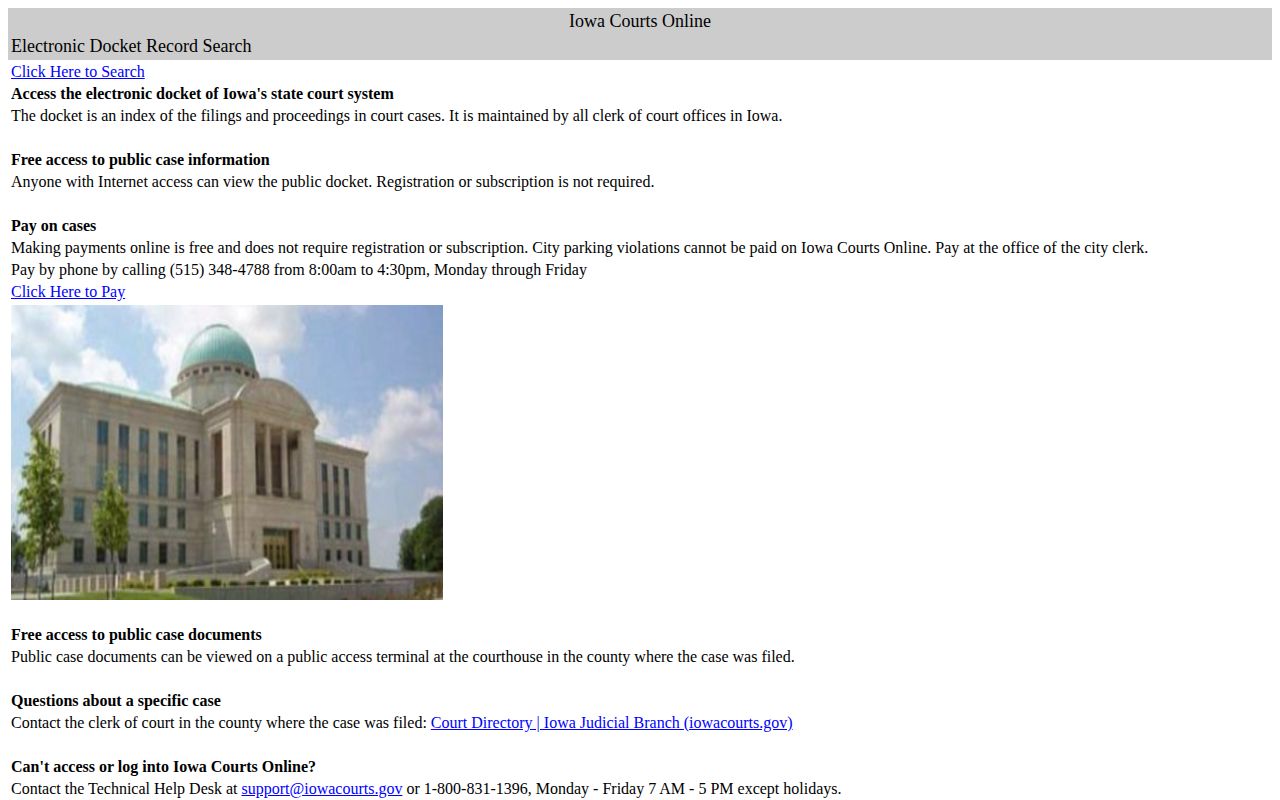
Match county, name, and case details with care. Then trust the docket or clerk, not an old arrest index, for the outcome.
Custody Beyond the Lyon County Jail
Someone missing from the Lyon County Jail roster is not necessarily free. Release is one option. Transfer is another. A detainee can also land in a whole different custody system, which is why one roster never tells the full story. Iowa DOC's Offender Search handles the state side, covering sentenced prisoners and people under supervision. Searches run by name, offender number, sex, location, offense, or county of commitment. The state warns that public records update weekly and can shift, so treat it as a record system rather than a live Lyon County booking feed. Offender photos do not appear there.
Federal custody works through its own tools. The Bureau of Prisons locator finds federal inmates but posts no public mugshot gallery. ICE's Online Detainee Locator handles immigration holds, not county arrests. Someone booked briefly at Lyon County Jail on a federal agency's behalf may simply vanish from the local roster once transferred. Each locator serves a narrow purpose. The county roster covers local custody, and the state system covers Iowa corrections. Each federal locator covers its own detainees.
Status labels deserve close reading. "Booked" means the jail finished processing an arrest. "In custody" describes a roster snapshot at one moment. "Released" ends the local hold but does not erase the arrest or settle the court case. "Sentenced" and "under supervision" belong to the corrections stage, after the court process moves along. Reading those terms in order prevents a common mistake. That mistake treats an old press-log entry as a current location. It also explains why one person can drop off the Lyon County Jail roster and later surface in a state or federal locator.
Conflicting answers call for comparison. Check each source's timestamp and its owner. The sheriff can confirm jail data. The clerk can explain a court docket. Iowa DOC controls offender records, and federal agencies run their own locators. Save the source URL, the date you checked, and the identifying details you used. That brief record keeps any follow-up request clear without republishing private information.
A blank search result proves nothing; call the agency holding the person.